Portraits: 14–16 November: Jack Davison
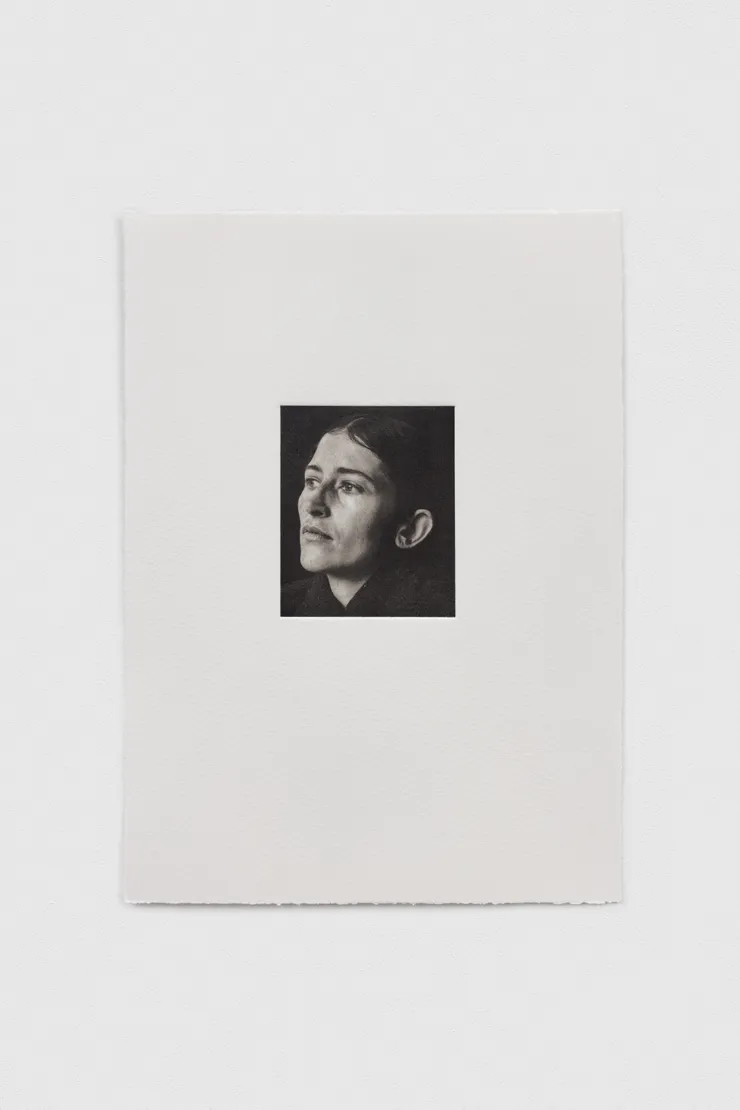
Cob Gallery are pleased to present the work in its entirety: all ninety portraits from the series, shown in the gallery and in the city where the project was first conceived. This body of work unites Davison’s lifelong commitment to portraiture with his recent exploration of photopolymer gravure printing, a process that brings tactile depth to the photographic object.
Conceived as the first chapter in an ongoing series, the project began in London, where Davison, in collaboration with casting director Coco Wu, street-cast individuals from across the city and photographed them over three days. What emerges is not a portrait of London, but a more intimate, personal register of encounter and presence.
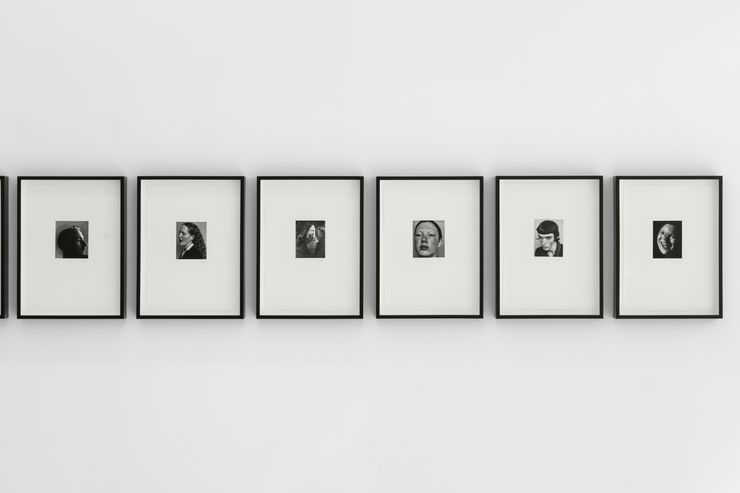
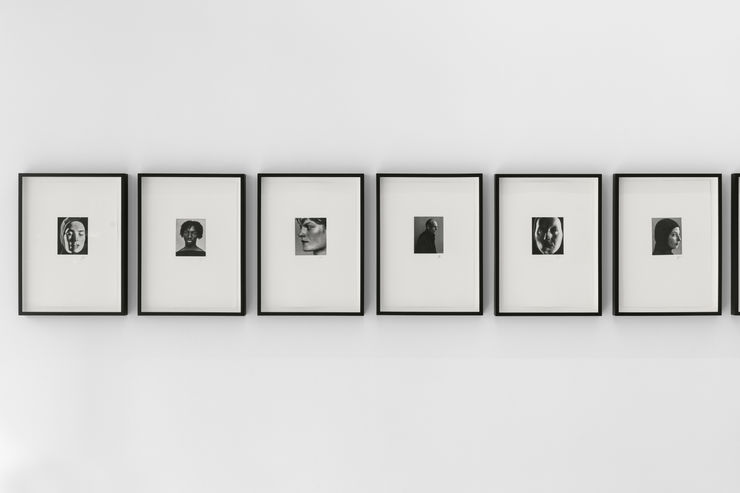
Installed as an immersive constellation within the gallery, the gravures surround the viewer with a continuous sequence of faces. Seen together, the portraits establish a quiet rhythm between individuality and collectivity. Printed at a deliberately intimate scale, the works function as small vernacular objects, closer in spirit to early mugshots, medieval icons, or Victorian silhouettes than to the monumental gestures of contemporary portraiture. Their modest size asks the viewer to lean in, to look slowly, and to engage in a form of attention that is physical as much as optical.
Formally, the portraits are marked by an austere economy of means. Davison pares the image back to head and shoulders, working exclusively in black and white, where light becomes sculptural and the face is treated as a site of compression and pressure. Hair, often a signifier of identity, era, or style, is frequently obscured or disciplined, allowing expression, skin, and bone structure to come forward. This act of simplification aligns the work with a lineage that runs from Alberto Giacometti’s relentless reductions to Ingmar Bergman’s searching close-ups, and the psychological intensity of Francis Bacon’s distorted visages, each returning, again and again, to the face as an unsolved problem.
While the images feel timeless, they are not nostalgic. Instead, they occupy a space where the classical and the contemporary collapse into one another, producing a kind of secular medievalism: portraits as devotional acts, faces as icons, repetition as ritual. The work resists spectacle in favour of proximity, offering not definitive statements but open encounters. As Davison continues the project across different cities, each iteration adds another chapter to a growing portrait of contemporary life, one built not through grand narratives, but through attention, patience, and the enduring mystery of the human face.
The presentation coincides with the launch of a new publication, self-published by Davison’s print press Helions and designed by Matt Willey. The book captures the full scope of the project and marks the first volume in an evolving series, produced annually in different cities.
-
 Jack DavisonPortraits: 14-16 November 2024 (Jenna), 2025Photopolymer intaglio29.7 x 21 cm
11 3/4 x 8 1/4 inEdition of 3 plus 2 artist's proofs(Edition record) -
Jack DavisonPortraits: 14-16 November (Annie), 2024 (printed 2025)Photopolymer intaglio29.7 x 21 cm
11 3/4 x 8 1/4 inEdition of 3 plus 2 artist's proofs(Edition record) -
Jack DavisonPortraits: 14-16 November (Damsel II), 2024 (printed 2025)Photopolymer intaglio29.7 x 21 cm
11 3/4 x 8 1/4 inEdition of 3 plus 2 artist's proofs(Edition record) -
Jack DavisonPortraits: 14-16 November (Dennis), 2024 (printed 2025)Photopolymer intaglio29.7 x 21 cm
11 3/4 x 8 1/4 inEdition of 3 plus 2 artist's proofs(Edition record) -
Jack DavisonPortraits: 14-16 November (Hugo), 2024 (printed 2025)Photopolymer intaglio29.7 x 21 cm
11 3/4 x 8 1/4 inEdition of 3 plus 2 artist's proofs(Edition record) -
Jack DavisonPortraits: 14-16 November (Emily II), 2024 (printed 2025)Photopolymer intaglio29.7 x 21 cm
11 3/4 x 8 1/4 inEdition of 3 plus 2 artist's proofs(Edition record) -
Jack DavisonPortraits: 14-16 November (Ivory), 2024 (printed 2025)Photopolymer intaglio29.7 x 21 cm
11 3/4 x 8 1/4 inEdition of 3 plus 2 artist's proofs(Edition record) -
Jack DavisonPortraits: 14-16 November (Holly), 2024 (printed 2026)Photopolymer intaglio29.7 x 21 cm
11 3/4 x 8 1/4 inEdition of 3 plus 2 artist's proofs(Edition record) -
Jack DavisonPortraits: 14-16 November (Grace C), 2024 (printed 2026)Photopolymer intaglio29.7 x 21 cm
11 3/4 x 8 1/4 inEdition of 3 plus 2 artist's proofs(Edition record) -
Jack DavisonPortraits: 14-16 November (Callum), 2024 (printed 2026)Photopolymer intaglio29.7 x 21 cm
11 3/4 x 8 1/4 inEdition of 3 plus 2 artist's proofs(Edition record) -
Jack DavisonPortraits: 14-16 November (Alexandra), 2024 (printed 2026)Photopolymer intaglio29.7 x 21 cm
11 3/4 x 8 1/4 inEdition of 3 plus 2 artist's proofs(Edition record) -
Jack DavisonPortraits: 14-16 November (Anouk & Kiki), 2024 (printed 2026)Photopolymer intaglio29.7 x 21 cm
11 3/4 x 8 1/4 inEdition of 3 plus 2 artist's proofs(Edition record)